Understanding collagen: terms, sources and context
Collagen is the most abundant structural protein in the human body. It occurs in skin, tendons, ligaments, cartilage and bone, and gives those tissues their mechanical form. As a supplement it is sold in very different forms, and the labels are hard to compare: type I, type III, hydrolysate, peptides, molecular weight in daltons, bovine or marine, powder or capsule.
This page explains those terms and shows how to assess a product based on its stated information. What we do not tell you is what collagen does for you. The data are not clear enough for that, and health-related statements about foods are strictly regulated. Instead, it offers a framework for checking the information yourself.
Collagen as a structural protein and types I, II and III
Collagen is not a single substance but a whole protein family. Twenty-eight types are described in humans, of which a few dominate by quantity. They share a very characteristic build: three protein chains wind into a triple helix. That structure is why collagen withstands tensile force, and it is also why the amino acid composition is unusual: glycine occupies every third position, alongside a great deal of proline and hydroxyproline.
Type I is the largest share by quantity in the body. It occurs in skin, tendons, ligaments and bone, forming fibres organised into bundles. It appears most often on product labels, frequently combined with type III.
Type II is the main component of hyaline cartilage, the tissue at joint surfaces. It forms a finer network than type I. Products declaring type II often source it from chicken cartilage.
Type III occurs together with type I, among other places in skin, blood vessels and internal organs. It forms finer fibres and makes up a larger proportion in young tissue than in older tissue.
What that means for a label. When a product declares “type I and III”, that describes the origin of the raw material and its tissue share, not a destination in the body. A label tells you what the powder consists of. It does not tell you where that protein ends up after you eat it: collagen is digested like any other dietary protein, that is, broken down into amino acids and smaller peptides. No targeted routing to a particular tissue follows from a type declaration.
Evidenced basis: the structural and type descriptions draw on the reviews by Shoulders and Raines on collagen structure and by Ricard-Blum on the collagen family. Both are linked in the sources section.
Direct source: Shoulders MD, Raines RT: Collagen structure and stability. Annual Review of Biochemistry (2009). · Ricard-Blum S: The collagen family. Cold Spring Harbor Perspectives in Biology (2011).
Sources, hydrolysate, peptides and molecular weight
Where the raw material comes from. Collagen for supplements comes from animal connective tissue. The common sources are bovine (hide, bone), porcine, fish (skin, scales) and poultry (cartilage). The source determines two practical things: the type profile of the raw material, and whether a product is an option for you at all, for instance with religious dietary rules, a fish allergy or a vegetarian diet. For people who avoid animal raw materials there is no equivalent plant collagen, because plants do not form this protein.
What hydrolysis means. Native collagen, in its triple helix, dissolves poorly in water. For supplements it is therefore hydrolysed: enzymatic cleavage produces shorter fragments, the collagen peptides. The result is a powder that dissolves in cold water and has little taste of its own. “Hydrolysed collagen”, “collagen hydrolysate” and “collagen peptides” describe essentially the same process outcome on the market.
Molecular weight: what the dalton figure states. Some labels give an average molecular weight in daltons (Da) or kilodaltons (kDa). The figure describes a technical characteristic of the raw material. We do not state a generally applicable market range or derive a product property from it without an appropriate direct source.
How to read that figure. It is a technological description of the raw material, not a statement about quality or outcome. Compare only values whose measurement method and frame of reference are stated clearly. Where the figure is absent, this comparison point remains open.
When the figure is missing. Not every label states a molecular weight. Where it is absent, the product simply cannot be compared on this point. That is not a fault in the product, but a gap in your basis for comparison, and it should not push you towards advertising claims instead.
Evidence limit: This reading aid does not derive any further product, selection or efficacy claim here.
Checking product labels: ingredients, serving and manufacturer details
A label is the only source of information legally tied to the specific product. Advertising copy is not. So it is worth reading in this order:
1. The ingredient list, top to bottom. Ingredients appear in descending order of weight. If collagen hydrolysate comes first, it is the main component. If fillers, carriers or sugar come before it, it is not.
2. The reference quantity. Figures apply per serving, per scoop, per capsule or per 100 grams. Two products are only comparable once you convert the figures to the same reference. This is the most common source of mistaken comparisons between two tubs on a shelf.
3. The animal species and source tissue. “Bovine collagen” is a different statement from “marine collagen from fish skin”. Both are permitted, but they are different raw materials.
4. Additives. Flavourings, sweeteners, anti-caking agents, acidity regulators. They are not a problem in themselves, but they often explain why one product weighs more or tastes different from another.
5. The address of the food business operator. Under the EU Food Information Regulation (Regulation (EU) No 1169/2011), the packaging must carry, among other things, the name of the food, the ingredient list, allergen labelling, the net quantity, the date of minimum durability and the address of the responsible business. Anything missing there is a factual signal to look closer.
6. What does not belong on a label. Statements attributing to a food the property of eliminating or averting a disease are not permitted for foods. If you read something like that on a pack or in a product description, that is a reason to look more carefully.
What a label cannot do. It says nothing about what the product does for you. It describes composition and quantity. That is precisely why it is useful: it is the part of the packaging that can be verified.
Direct source: Regulation (EU) No 1169/2011 on the provision of food information to consumers (2011).
Placing cofactors on the label
Besides collagen hydrolysate, many collagen products contain further ingredients, often vitamin C (frequently as acerola extract), sometimes zinc, copper, manganese, silicon, selenium or biotin. Marketing calls them “cofactors”. This page describes them as what they are on the pack: further ingredients of the formulation.
Why we make no nutrient statements here. Authorised health claims exist for vitamins and minerals with exactly prescribed wording. That wording is language-specific, may not be freely rephrased or translated between languages, and is tied to conditions of use, in particular a sufficient quantity in the specific product. Whether a given product meets those conditions depends on that product’s label, not on a guide page. As long as that is unverified for the context described here, we do not make the statement. This restraint is deliberate.
What you can do instead. Read the cofactor ingredients as comparison features:
- Is the ingredient there at all? A formulation name such as “with acerola” says nothing about quantity.
- What amount per reference quantity is declared? Nutrient figures appear in the nutrition table, usually with a percentage of the reference intake.
- Is the form named? “Acerola extract” and “ascorbic acid” are different statements.
- Add things up. If you take several preparations, nutrients accumulate across all of them. That is a reason to lay labels side by side rather than reading each on its own.
If you want more precision, the nutrition table of the specific product is the binding source, and for personal questions a doctor or a pharmacy.
Evidence limit: This reading aid does not derive any further product, selection or efficacy claim here.
Product forms as a decision aid: powder, capsules, liquid
Collagen hydrolysate is sold in three forms. They differ in handling, not in raw material. Which suits you depends on your routine, not on a ranking.
Powder. The most common form. It is stirred into water, coffee or yoghurt and usually has little noticeable taste. Practical: the serving size is freely chosen with the scoop, and the ratio of content to packaging is favourable. Impractical: it needs a drink, a scale or a spoon, and travels badly.
Capsules. Practical: precisely portioned, taste-neutral, portable, no stirring. Note: a capsule holds considerably less powder than a scoop, so a powder serving corresponds to a good many capsules. Do that arithmetic when comparing two products; it is exactly the reference-quantity trap from the label section.
Ready-to-drink liquids. Ampoules or shots. Practical: no preparation, fixed portion, good for travel. Note: they often also contain water, flavourings and sweeteners, and the packaging per serving is larger. Read the ingredient list here especially carefully.
What applies to all three. The form changes nothing about the composition of the collagen fraction. We recommend no form as the most suitable and deliberately state no quantities: both would be an intake recommendation, and we have no robust basis for one. The manufacturer’s information on the specific product is the relevant source.
Evidence limit: This reading aid does not derive any further product, selection or efficacy claim here.
Target groups and exclusions: when a collagen product is not an option
Rather than asserting groups with a need, we name two things that can be checked: why people take an interest in the topic, and when a product is factually ruled out.
Reasons for interest. People typically arrive at collagen by three routes: an interest in protein sources in the diet, coverage in media and social networks, or a search for a supplement that fits an existing routine. All three are understandable. None of them is evidence that a product makes sense for you.
Clear exclusions. In these cases a conventional collagen product is ruled out, regardless of any assessment:
- A vegetarian or vegan diet. Collagen is an animal protein. There is no plant collagen, because plants do not form it. Products sold as a “vegan collagen alternative” contain no collagen but other ingredients. That is a different product, not a substitute.
- Fish or shellfish allergy. Marine collagen comes from fish. The allergen labelling on the pack is the decisive point here.
- Avoiding beef or pork for religious or personal reasons. The species is on the label and is the point to check.
- A known intolerance to one of the other ingredients, such as a sweetener or a flavouring.
Cases where we expressly refer you to professional advice. Pregnancy, breastfeeding, existing illness, ongoing medication, children and adolescents. We make no statement about any of these groups, because a general figure would not do justice to an individual situation. In these cases, speak to a doctor or a pharmacy.
And an honest note to close. Collagen is a dietary protein. A supplement does not replace a diet, and a product is not a precondition for being well. If you are unsure whether you need one at all, that is a sensible question, and the honest answer may be no.
Evidence limit: This reading aid does not derive any further product, selection or efficacy claim here.
Label-reading examples
Label-reading examples
The following cards are used only to read the label information at the respective destination. They make no statement about selection, suitability, quality or formulation.
Affiliate notice: The following label-reading examples include product references. introdrink.ch may receive a commission if a purchase is made through linked offers.
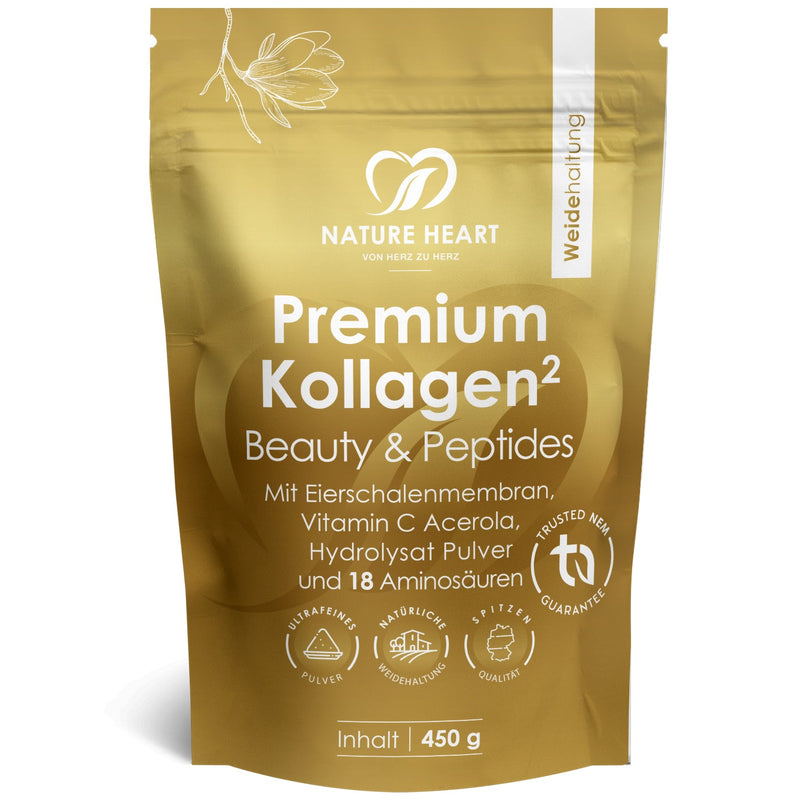
Label-reading example 01
Premium Kollagen
This label-reading example points to the information on the specific product.
The card makes no statement about selection, suitability, quality or formulation.
Check label details at the destination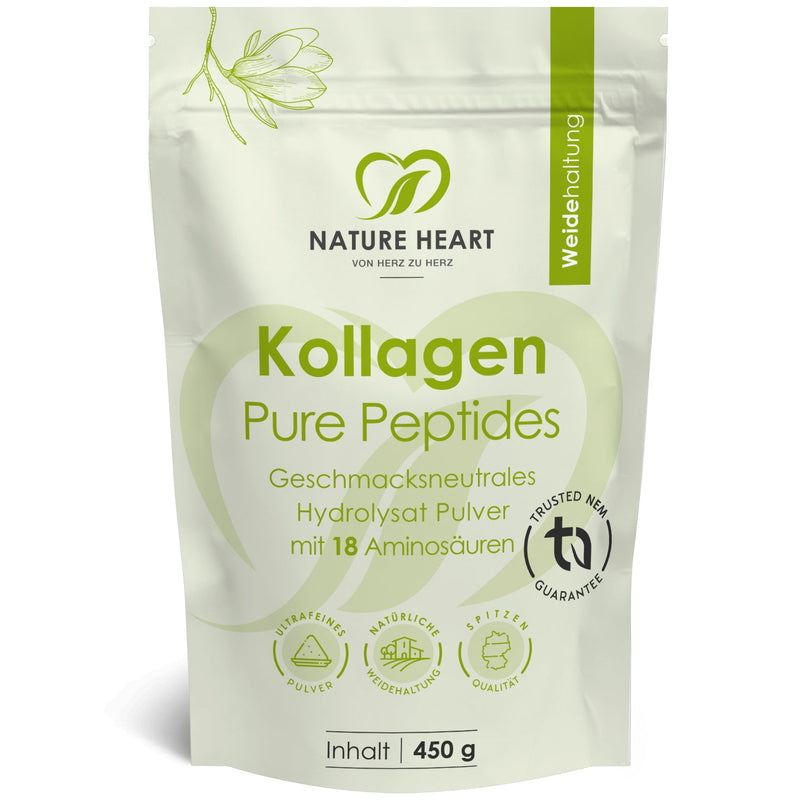
Label-reading example 02
Kollagen Pure Peptides
This label-reading example points to the information on the specific product.
The card makes no statement about selection, suitability, quality or formulation.
Check label details at the destination
Label-reading example 03
Vitamin C Acerola
This label-reading example points to the information on the specific product.
The card makes no statement about selection, suitability, quality or formulation.
Check label details at the destinationThe three cards are label-reading examples. They make no claim about selection, suitability, quality or formulation.
Connective tissue and joints: keeping structural terms and product questions apart
When collagen comes up, two vocabularies almost always arrive together: the anatomical (“connective tissue”, “cartilage”, “tendon”) and the commercial (“for your joints”). This page keeps them apart, because only the first can be described.
What connective tissue is anatomically. Connective tissue links, shapes and carries other structures. It consists of cells and a surrounding extracellular matrix, and that matrix contains, besides water and proteoglycans, mainly collagen fibres. In skin those fibres lie as a network; in tendons and ligaments they run in parallel, because there they take tension in one direction.
What cartilage is. The hyaline cartilage at joint surfaces is a particularly water-rich tissue. Its resistance to pressure arises from the interplay of proteoglycans, which bind water, and a network of type II collagen holding that swollen tissue together. Cartilage has no blood supply of its own; it is served by the joint fluid.
Why no product statement follows from that. The fact that a tissue contains collagen says nothing about what an ingested collagen product does at that tissue. Ingested protein is digested and used in the body as a pool of building blocks, without any destination following from the origin of a raw material. Presenting it otherwise turns an anatomical description into a product claim. That boundary is exactly why no sentence on this page connects a collagen product to a joint.
What you can do with this distinction. It is a filter for advertising copy. If a product description jumps straight from anatomy to product benefit without naming a study with a population and an endpoint in between, the gap is precisely at that point.
Direct source: Ricard-Blum S: The collagen family. Cold Spring Harbor Perspectives in Biology (2011).
Hormonal context: menopause as a physiological frame
The relationship between oestrogen and the collagen content of skin is a research topic in its own right. It is described here because it is frequently searched for, and it is kept cleanly apart from any product question.
The relationship as described. In the research literature, the collagen content of skin has been studied as a quantity that changes around the time of the menopause. Brincat and colleagues published measurements on this in the 1980s; the work is linked in the sources section. It is a physiological observation in a particular group, not a statement about a product.
What does not follow from it. From this research context, no connection can be derived between a collagen product and experiences around the menopause. The quantity studied is the collagen content of a tissue, not the question of what an ingested collagen powder changes about it. Jumping from the one observation to the other statement skips exactly the study that would be needed.
Why we keep it anyway. Because the question is legitimate, and because dropping the topic does not answer it but only moves it elsewhere. You should know the observation and also see where it ends.
For personal questions around the menopause, medical advice is the right route. This page does not replace it and does not try to.
Reading the research: study type, population and endpoint
Studies on collagen peptides exist. Citing them is easy; placing them is the actual work. These four questions do most of it:
1. Which study type? A cell culture study observes cells in a dish. An animal study observes a different organism with a different metabolism. A controlled human study with blinding and a control group is fundamentally different and can support conclusions only within its study population and design. When a product description names “studies” without naming the type, that is the first thing to check.
2. Which population? Who was measured? Number of participants, age, sex, starting point. A study in thirty people of a particular age group describes that group. It does not automatically describe you.
3. Which endpoint? What exactly was measured, and with what? An instrument reading, a questionnaire and a subjective self-assessment are three different things. Endpoints defined after looking at the data are weaker than those defined in advance.
4. Who funded it? Manufacturer funding does not make a study wrong, but it belongs to the appraisal, as does the question of whether results have been independently repeated.
What one result is worth. One study alone is not enough for a general conclusion. A finding becomes more reliable when several independent groups measure in the same direction with comparable methods. Until then it points to an open question rather than delivering an everyday conclusion.
Why there is no results list on this page. Because such a list inevitably reads as a promise, even when every individual item is cited correctly. Instead we give you the tool to check any study claim yourself, including the one on a pack.
Direct source: Schulz KF, Altman DG, Moher D: CONSORT 2010 Statement for reporting parallel-group randomised trials. BMJ (2010).
Frequently asked questions about collagen
Sources, affiliate notice and limits
Sources. The factual statements on this page draw on the linked works on collagen structure and the collagen family, on the EU Food Information Regulation (Regulation (EU) No 1169/2011) for the label particulars, and on the work named in the hormonal context section. All are linked directly and accessible without registration.
- Shoulders MD, Raines RT: Collagen structure and stability. Annual Review of Biochemistry (2009).
- Ricard-Blum S: The collagen family. Cold Spring Harbor Perspectives in Biology (2011).
- Regulation (EU) No 1169/2011 on the provision of food information to consumers (2011).
- Schulz KF, Altman DG, Moher D: CONSORT 2010 Statement for reporting parallel-group randomised trials. BMJ (2010).
- Brincat M et al.: Decline in skin collagen content and metacarpal index after the menopause and its prevention with sex hormone replacement. British Journal of Obstetrics and Gynaecology (1987).
Affiliate notice. introdrink.ch is funded by commission. If you buy a product through the product references on this page, a payment may arise from that. The selection of the products described follows the label features explained in this text.
Scope. introdrink.ch is a guide portal, not a shop. We hold no stock, process no orders and make no statements on prices, shipping, customs, taxes, payment methods, delivery times or returns. Those points are handled solely by the respective provider.
Limits of this page. We describe label features, terms and research methodology. We do not test individual products in a laboratory, we do not rate one formulation above another, and we make no statement about what a product does for you. Where a detail is missing, we say so rather than filling the gap with a plausible-sounding phrase.
Follow label features in context
You now know the terms that appear on a collagen pack, and in which order a label can be read. The most useful next step is to work through it on a real product: ingredient list top to bottom, reference quantity, species, type profile, molecular weight, additives.
Check label details at the destinationWhat always counts is the manufacturer and label information for the specific product. For personal health questions, medical or pharmacy advice is the right route.